What It Really Means to Be Responsible for Someone Else’s Dog
A recent Ontario Court of Appeal decision has been circulating in dog care circles. A dog walker was attacked while on the job and attempted to sue the dog’s owners. The appeal was dismissed because, under Ontario’s Dog Owners’ Liability Act, she was considered the owner of the dog at the time of the incident.
For many people in this industry, that outcome came as a surprise. For us, it didn’t. Not because we follow the news closely, but because this interpretation of the law has always been the foundation of how we operate. The person in control of the dog carries the responsibility. That has never been ambiguous. If the ruling had gone the other way, we would have had to reconsider everything. But it didn’t, because the law has always said what we always understood it to say. What it brought to the surface is a conversation this industry needs to have more openly. We’ve been having it quietly, through every intake assessment, every difficult decision, every walk.
When You Take the Leash, You Take Everything With It
There is a version of dog walking that looks simple from the outside. You show up, you clip on the leash, you walk. The dog is happy, the owner is grateful, and everyone goes home. That version exists, and it’s lovely. But it isn’t the whole picture.
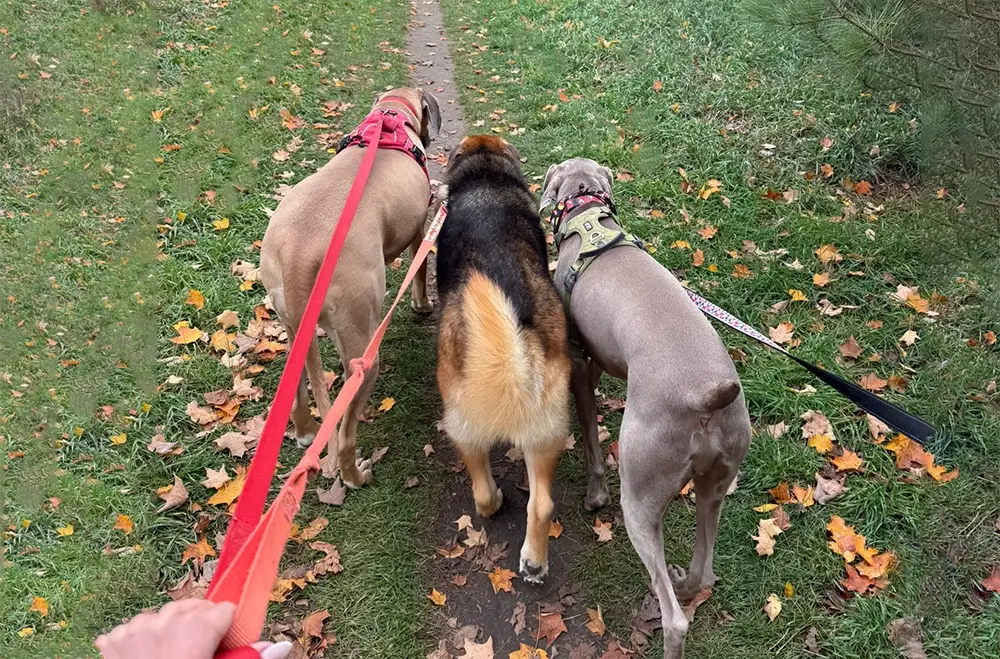
The moment a dog enters our care, our role becomes something more layered than companionship and exercise. For us, this has never been a liability concern in the legal sense. It has always been a professional one. We are managing how that animal interacts with the world around them, with other dogs, with strangers, with unpredictable environments and unexpected situations. That responsibility doesn’t diminish because we love what we do. It exists precisely because we chose to take it on.
Understanding the weight of what you’re holding is what separates care from service.
Responsible Dog Walking Begins Before the First Walk
This is why our intake process looks the way it does. Before any dog joins our program, we assess them carefully, not just for compatibility with the group, but for behavioural patterns, reactivity triggers, and how they respond when things don’t go as expected.
We want to understand the dog as an individual. How do they move in unfamiliar spaces? How do they respond to other dogs they haven’t met? What does stress look like for them, and how quickly do they recover? These aren’t bureaucratic questions. They are the foundation of safe, ethical dog handling.
This process takes time, and it requires honesty from everyone involved, including us. It means sometimes slowing down before we say yes.
When We Need to Let Go, and Why
There are moments in this work when the most responsible decision is to step back. We have declined dogs before they joined our program. We have also ended services mid-way, when a situation evolved beyond what we could safely manage.
These conversations are never easy. The owners love their dogs, and stepping back requires honesty on both sides. But when a dog displays behaviour that puts other animals, our team, or the community at risk, continuing would be the wrong choice, regardless of how much we care.
Letting go in those moments isn’t an absence of compassion. It is what compassion looks like when it’s grounded in professional judgment rather than the desire to accommodate. And it is one of the harder things this work genuinely asks of us.
Good Intentions Need a Safety Net
Even with the strongest systems in place, risk cannot be eliminated entirely. And we say that with full awareness that a situation like the one in that Ontario case could have happened to us. Not because we are careless, but because we work with animals in real, unpredictable environments. That is the honest reality of this work, and pretending otherwise wouldn’t serve anyone.
This is why we invest continuously in our team’s knowledge of canine behaviour. Every member of our staff is trained to read the signs that most people miss, the subtle shifts in body language that signal discomfort, reactivity, or the early stages of a situation that needs to be managed before it escalates. That knowledge doesn’t eliminate risk. But it changes how we move through it.
It is also why we carry professional insurance through ProFur. If something goes wrong despite every precaution, there is a structure in place that protects our clients, our team, and the animals in our care. Insurance isn’t a fallback for carelessness. It is what responsible operation looks like when it’s taken seriously.
Caring deeply about dogs is the starting point. Structure, training, and accountability are what make that care sustainable.
This Is What Professional Dog Care Actually Looks Like
The Ontario ruling didn’t tell us anything we didn’t already know. But it gave language to something that matters: responsibility in dog care is not a feeling. It is a practice, built from knowledge, structure, honest assessment, and the willingness to make difficult decisions when the situation calls for it.
When you trust someone with your dog, you are trusting them with an animal that depends entirely on the quality of the judgment being exercised on their behalf. That trust deserves professionals who understand exactly what they are taking on.
Every single time the leash changes hands.